
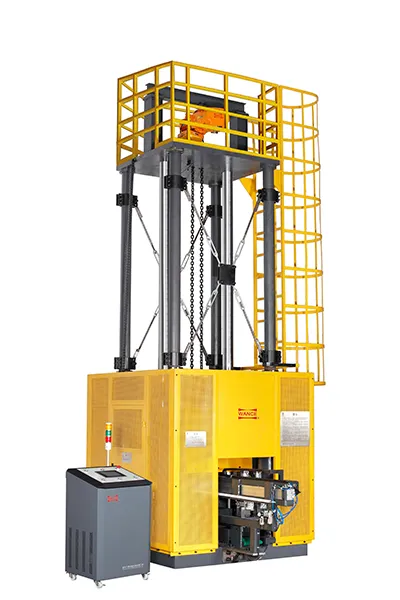
Drop Weight Impact Testing Machine for Metals, Drop Weight Tear Test (DWTT)
The drop weight impact testing machine integrates mechanical, electrical, and automated control technologies to achieve a fully automated workflow, including specimen feeding, weight lifting, impact execution, fractured specimen collection, and weight retracting. Multiple safety mechanisms are incorporated throughout the system, greatly enhancing operator safety and equipment protection. The testing machine is specifically designed for drop weight tear tests (DWTT) on ferritic steels. The test is used to evaluate the fracture appearance of specimens fractured in a single impact event within the temperature range where ferritic steel transitions from brittle to ductile behavior. The principle of the DWTT test is to lift a defined weight to a predetermined height and release it from rest. The drop weight then falls freely to strike and tear the material. After the impact, the fracture surface is examined to identify the characteristic fracture modes.
The DWTT machine is used to perform drop weight tear tests on pipeline steels and medium-thick ferritic steel plates, determining their tear resistance and fracture behavior under dynamic loading.
ASTM E436, API RP 5L3, GOST 30456, GB/T 8363
- The drop-weight impact platform incorporates a servo-motor lifting mechanism that delivers high control precision and accurate positioning. Smooth acceleration and deceleration at the start and end of the lifting minimize mechanical shock to the motor and extend service life.
- A Siemens PLC paired with a Taiwan-made touchscreen provides a highly reliable control architecture with excellent anti-interference capability, strong adaptability and scalability, and minimal maintenance requirements.
- Automated specimen feeding and positioning greatly simplify operation and enhance overall testing efficiency.
- The test frame features a split column architecture with four robust vertical columns and a solid steel base plate machined from a single block. This structure ensures exceptional rigidity and rock-solid stability during high-energy impact events.
- A Japan-made 12.5mm anchor chain is used for hammer lifting. Compared with conventional wire ropes, the anchor chain offers lower elasticity, resulting in more accurate height measurement, as well as higher strength, reduced wear, and improved operational safety.
- Secure weight-release with dual safety monitoring: The release mechanism features an automatic self-locking structure. Once lifted, the weight is securely latched and cannot disengage under its own weight.
- A pair of custom hydraulic buffer cylinders, specifically engineered for the characteristics of drop-weight tear testing, absorb residual impact energy and withstand high impact velocities. The symmetric layout effectively reduces structural shock and prolongs equipment lifespan.
- An integrated specimen-recovery mechanism automatically transports specimen debris out of the enclosure, eliminating the need for operators to reach inside the equipment, improving workflow efficiency while enhancing operator safety.
- A fully enclosed safety guard combined with multiple protective interlocks ensures comprehensive safety throughout the testing process. The intelligent control system provides real-time fault monitoring and alarms for conditions such as improper specimen positioning, weight not locked, safety-guard faults, and incomplete weight lifting, enabling rapid troubleshooting and safer operation.
| Model | | | | |
| Max. energy, J | 30000 | 50000 | 80000 | 100000 |
| Minimum energy, J | 8000 | 20000 | 20000 | 20000 |
| Tup mass, kg | 630 | 1600 | 1620 | 1620 |
| Tup mass accuracy | ±1% | |||
| Weight mass, kg | 390 (13x30) | 360 (12x30) | 780 (26x30) | 870 (29x30) |
| Weight mass accuracy | ±0.5% | |||
| Total weight | 1020 | 1960 | 2400 | 2490 |
| Drop height, mm | 1275-3000 | 1275-2600 | 1275-3400 | 1275-4130 |
| Velocity of drop, m/s | 5-7.67 | 5-7.13 | 5-8.16 | 5-9 |
| Striker lifting speed, m/min | 4 | |||
| Height accuracy, mm | ≤±10 | |||
| Hardness of tup nose | HRC58-62 | |||
| Radius of tup nose, mm | R25±0.1 | |||
| Hardness of support anvil | HRC58-62 | |||
| Alignment accuracy, mm | ≤±1.5 | |||
| Support anvil span, mm | 254±1.5 (ASTM E436 & API RP*5L3) 250±2 (GOST 30456-97) | |||
| Specimen dimension, mm (Length x Width x Thickness) | (305±19) x (76.2±3) x (3-50) (ASTM E436 & API RP*5L3) (300±5) x (75±2) x (3-50) (GOST 30456-97) | |||
| Weight, kg | 10000 | 15000 | 19000 | 20000 |
| Electric supply | AC 380V, 50Hz, 3-phase, 5-line | |||
| Power | 20A, 5kW | |||
We also provide a variety of accessories for all types of mechanical testing equipment.